

Sinagua Malt Wins the 2026 Sedona Innovation Award
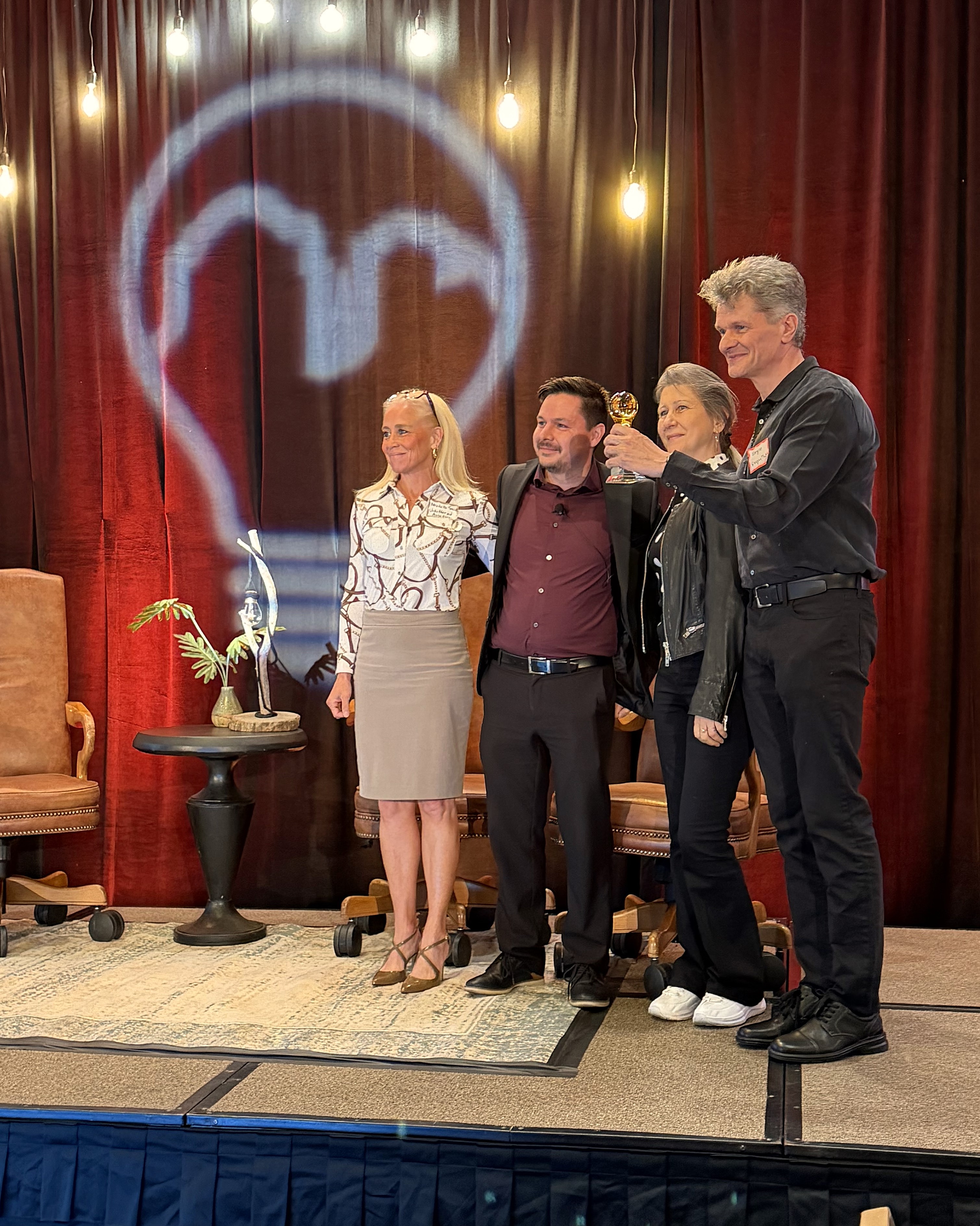
We won! Sinagua Malt has been named the winner of the 2026 Sedona Innovation Award, presented by the Greater Sedona Chamber of Commerce & Tourism Bureau at the Sedona Innovation Summit at Enchantment Resort on October 1, 2026.
This year the Chamber’s Innovation Award Committee selected seven finalists, “Sedona’s Seven”, from businesses working in clean energy, water technology, wellness, medicine and community service. Being chosen from such an inspiring group is a real honor, and we’re grateful the committee recognized a simple idea: conservation works best when it’s built into the business itself.
In accepting the award, we said:
“We couldn’t have done this without the support of our community. We believe AI will shape the future by enabling a shift away from one-size-fits-all products made by big corporations, toward many small businesses serving their local communities with tailored products and services. With our malthouse, we’ve taken one step in that direction.”
Why barley saves water
The Verde River runs lowest in the hottest months, which is exactly when traditional crops like alfalfa and corn need the most irrigation. Malting barley is different. It grows through the winter and is harvested by early summer, before the river drops. According to The Nature Conservancy, barley uses roughly a quarter of the water that alfalfa does. Every field that switches to barley leaves summer water in the river.
Farmers can only make that switch if someone buys their barley and turns it into malt that brewers want. That’s our job. Since the first barley was planted in 2017 with The Nature Conservancy and Verde Valley farmers, the program has kept hundreds of millions of gallons of water in the Verde. This year alone, together with our brewing partners, we kept 151,000,000 gallons of water in the Verde River.
The One Man Factory
When we took over Sinagua Malt in 2023, we knew the conservation model worked. The challenge was making it last. A small, labor-intensive malthouse couldn’t produce enough malt, at a price brewers could afford, to keep growing the number of acres planted in barley.
Our answer was a concept we call “The One Man Factory.” We rebuilt the facility from the ground up and automated it so that it can run 24 hours a day, 7 days a week, with a single person on site. Steeping, germination, kilning and handling are monitored and controlled by systems we designed and built ourselves.
That’s what made the water savings scale. Automation increased our processing capacity eightfold, to more than 30 tons of malt a week, and kept our costs competitive with large national maltsters. More malt sold means more barley contracted, more acres converted, and more water left in the Verde River.
Saving water you can’t see
We also looked at the water footprint most businesses never think about.
We don’t use evaporative cooling. In the Arizona desert, evaporative “swamp” cooling is the default for keeping buildings and equipment cool, and it works by evaporating large amounts of water. Our malthouse controls temperature without it. We use closed-loop chillers, which recirculate the same coolant instead of evaporating water, insulated germination drums that hold a steady temperature with far less cooling, and heat pumps that move heat where it’s needed. The water we help save in the field isn’t spent again in the factory.
Our software runs here, not in the cloud. Every cloud service and subscription app runs in a data center somewhere, and in Arizona those data centers need water. Their water use for cooling varies widely. A large data center using evaporative cooling can use up to about 4 million gallons a day, and generating the electricity that powers them uses even more water indirectly.
So we brought our technology home. The software behind the One Man Factory, along with our customer management, invoicing and even this website, is hosted on servers we own and operate locally. We don’t depend on cloud platforms or software-as-a-service subscriptions. That keeps our reliance on data centers to a minimum. It also makes the factory more reliable: our automation runs as a closed system, so an internet outage, a vendor shutdown or a subscription change can’t stop production. Every outside service we don’t depend on is one less thing that can fail.
Join us at Sinagua Maltstock
We’ll celebrate with the people who made it happen at Sinagua Maltstock, the beer festival organized by Arizona Wilderness Brewing, on November 7. We’ll launch the festival t-shirt there, featuring new artwork that celebrates the Verde River and the 51 million gallons we kept flowing this year. Come raise a pint with us!
Thank you
This award belongs to everyone who makes the model work:
- Our farmers, who changed how they farm to protect the river they depend on.
- The Nature Conservancy, whose vision started it all, and Chip Norton and Steve Ayers, who founded Sinagua Malt and built the foundation we stand on.
- Our brewing and distilling partners, whose orders for Arizona malt keep barley in the ground and water in the river.
- The Greater Sedona Chamber of Commerce & Tourism Bureau, the Innovation Award Committee, and our fellow finalists. It was an honor to stand alongside them.
Every bag of Sinagua Malt means a little more water in the Verde. If you brew or distill and want to be part of it, request a malt order account, read the story of our malthouse, or learn more about our water conservation work.
Sergio and Ofelia Goma Sinagua Malt, Camp Verde, Arizona, October-2026